

7 Best Home Air Conditioning Units for Year-Round Comfort
Last Updated: November 13, 2026
Quick Summary
For the best home air conditioning, choose a portable unit for single-room cooling and renters, or a fixed split system for quieter, more even whole-home comfort. Match cooling capacity to your room's real heat load, not just its floor area, and compare efficiency ratings rather than purchase price alone.
- Portable units need no permanent fixings and suit renters cooling a single room.
- Split systems cost more upfront but run quieter, cool more effectively and last longer.
- Use roughly 100 BTU per square metre as a starting point, then adjust for glazing and occupancy.
- Work out running costs by multiplying power input in kilowatts by hours and your unit rate.
- Clean or replace filters every few months during heavy use to protect performance.
Table of Contents
- How We Chose the Best Home Air Conditioning Units
- The Best Portable Air Conditioner for Home Use
- Portable vs Split Air Conditioning: Which Suits Your Home?
- Choosing an Air Conditioning Unit for Bedroom Comfort
- Cooling Capacity, BTU Ratings and Room Size
- Running Costs, Energy Efficiency and Refrigerants
- Air Conditioning Maintenance and Product Lifespan
- Arranging a Home Air Conditioning Survey
- Frequently Asked Questions
How We Chose the Best Home Air Conditioning Units
Choosing the best home air conditioning units starts with matching the unit to the room, not to the brochure. At B&G Jenkins, we have installed and serviced heating and cooling systems across the Swindon area since 1967.
We judged every option in this guide on five things:
- Cooling capacity against real room size, not the manufacturer's optimistic ceiling
- Noise levels, because a unit that keeps you awake at night is not doing its job
- Running costs and energy efficiency, including how the unit behaves on a mild day
- Installation practicalities in older properties, from window kits to wall fixings
- Maintenance and lifespan, since a neglected unit loses performance quietly
Here is the honest answer up front: for a single room, a portable unit is the simplest route. For whole-home comfort, a fixed split system is the better long-term investment. Below, we break down both so you can decide which fits your property.
The Best Portable Air Conditioner for Home Use
A portable air conditioner on castors that vents through a window kit needs no permanent fixings and can move between rooms. When comparing units, look for a sensible exhaust hose, a window sealing kit, and a drainage option for humid spells.
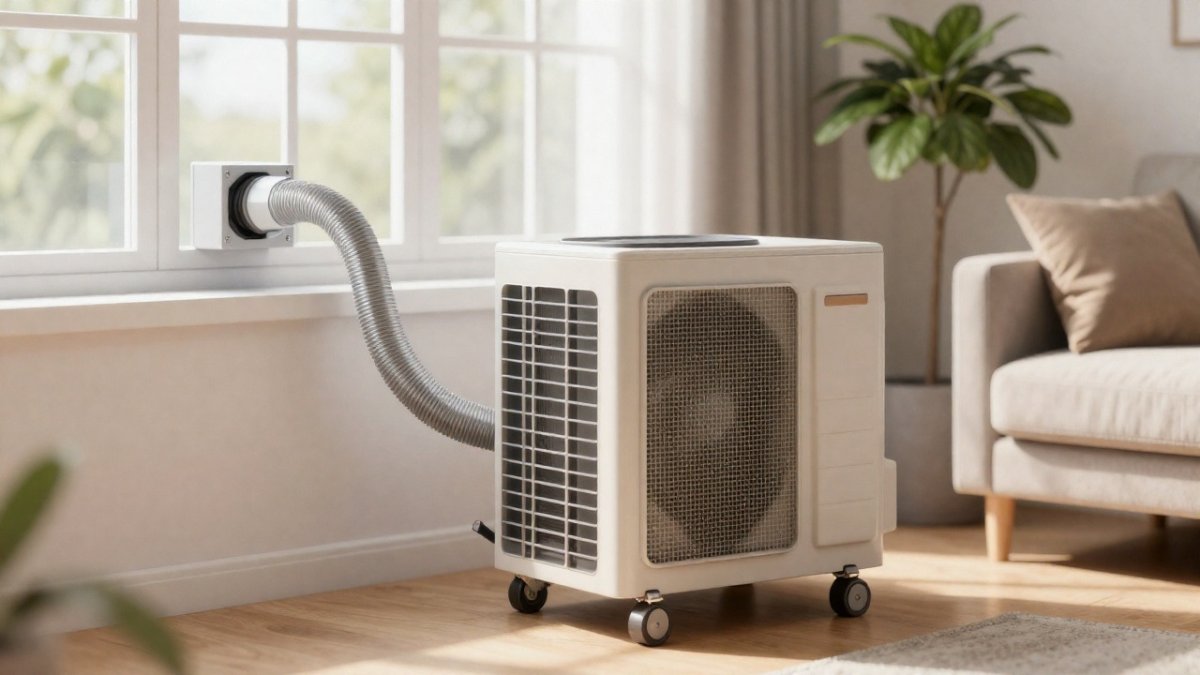
Venting is an important detail. A portable unit that exhausts into the same room simply moves heat around, so the window kit matters as much as the cooling capacity.
Practical points we would check before buying:
- Castors and weight: you will move it, so check both
- Window kit quality: a poor seal lets warm air straight back in
- Noise level: portable units are noisier than split systems, so check the decibel rating
- Drainage: most units collect condensate, and some need manual emptying
Best for: renters and single-room cooling where fixings are not an option. Skip if: you want quiet operation in a bedroom or need to cool several rooms at once.
Portable vs Split Air Conditioning: Which Suits Your Home?
Portable versus split air conditioning comes down to one trade-off: flexibility against long-term comfort. A portable unit is cheaper to buy and needs no installation, while a split system costs more upfront but runs quieter, cools more effectively, and lasts longer.
| Feature | Portable Unit | Split System |
|---|---|---|
| Installation | None, window kit only | Professional wall mounting |
| Noise | Higher | Lower |
| Cooling a room | Good for one room | Better, more even |
| Multi-room | No | Yes, with multi-split |
| Lifespan | Shorter | Longer |
| Upfront cost | Lower | Higher |
If you own your home and plan to stay, a fixed system usually makes more sense over time. If you rent, or only need relief in one room during a heatwave, a portable unit is the sensible budget option.
For households weighing up a permanent installation, our guide to planning home air conditioning installation walks through what a survey involves and how to prepare.
Choosing an Air Conditioning Unit for Bedroom Comfort
An air conditioning unit for bedroom use needs to be quiet above all else. Cooling performance matters, but a unit that runs loudly will cost you sleep, which defeats the purpose.
Three features to prioritise:
- Sleep mode, which gradually adjusts temperature through the night
- Quiet mode, usually a lower fan speed with reduced noise
- A timer, so the unit switches off once the room has cooled
For a bedroom, a wall-mounted split system is generally the quieter choice compared with a portable unit, and the indoor unit sits high up out of the way. If a portable unit is the only option, place it as far from the bed as the exhaust hose allows.
Watch out: placing a portable unit too close to curtains or bedding can restrict airflow and reduce cooling performance noticeably.
Cooling Capacity, BTU Ratings and Room Size
Cooling capacity is measured in BTU (British thermal units), and getting it right is the single biggest factor in whether a unit feels effective or disappointing. An undersized unit runs constantly, never quite reaches the set temperature, and wears itself out. An oversized unit cools the air too quickly, cycles on and off, and removes less humidity, so the room feels clammy even when the thermostat says otherwise.
As a working starting point, most practitioners use roughly 100 BTU per square metre of floor area for a typical room with a standard 2.4-metre ceiling, average insulation and one window. That is a starting point, not a specification. The assumptions behind it matter as much as the number.
| Room type | Typical floor area | Starting capacity guide |
|---|---|---|
| Small bedroom or study | Up to 10 m² | Around 1,000-1,200 BTU |
| Standard bedroom | 10-15 m² | Around 1,200-1,800 BTU |
| Living room | 20-30 m² | Around 2,000-3,500 BTU |
| Open-plan living and dining | 30-45 m² | Around 3,500-5,000 BTU |
| Large open-plan or loft room | 45 m² and above | 5,000 BTU and upwards, survey advised |
Those figures are indicative only, and they assume a room that behaves typically. In practice, five things push the required capacity up or down:
- Ceiling height: a room with a 3-metre ceiling has considerably more air to cool than one at 2.4 metres, even at the same floor area.
- Sun exposure and glazing: a south-facing room with large, unshaded windows gains far more heat than a north-facing room of the same size. Conservatory-style glazing can double the load.
- Insulation and draughts: a well-insulated modern room holds cool air; a period property with single glazing and open chimneys loses it.
- Occupancy: each person adds roughly 100 watts of heat, so a room used by four people needs more capacity than the same room used by one.
- Appliances and equipment: televisions, computers, games consoles and kitchen appliances all add heat load, which is why a home office or a room above a kitchen often needs more capacity than its floor area suggests.
A common situation is a homeowner buying a portable unit rated for the floor area alone, then finding it struggles in a sunny, well-occupied living room. The fix is not a bigger unit blindly, but a proper heat-load calculation. A survey measures the room, checks the glazing and insulation, and confirms the electrical supply, rather than guessing from a room-size label on a box. A heat-load calculation can also help balance cooling needs against energy use, with Air CareSaver offering a related perspective on choosing an efficient unit.
If you are unsure which capacity suits your property, you can contact our team to talk through the room and the options before you commit to anything.
Starting cooling capacity guide by room type
Running Costs, Energy Efficiency and Refrigerants
Running costs depend on three things: the unit's energy efficiency, how many hours it runs, and your electricity tariff. Because tariffs vary and units differ, the honest way to compare is to work out the method rather than quote a single figure that will be wrong for most households.
The method is straightforward. Find the unit's power input in kilowatts (often shown on the rating plate or in the manual), multiply by the hours you expect to run it, then multiply by your electricity unit rate in pence per kilowatt-hour. A unit drawing 1 kW for five hours a day uses 5 kWh; at a typical domestic rate that is a meaningful daily cost, and it is the figure worth comparing between models rather than the purchase price alone.
Efficiency is expressed through the energy label. Look for the seasonal efficiency ratings for cooling (SEER) and, where the unit also heats, for heating (SCOP). A higher rating means more cooling or heating per unit of electricity. A more efficient unit costs more upfront but uses less electricity over its life, which matters most if you plan to run it through summer and into heating season. We would always recommend asking for the efficiency figures in writing rather than relying on a sales description.
Modern units increasingly offer a heating mode as well as cooling, effectively acting as an air source heat pump. That can make a fixed system a genuine year-round comfort option rather than a summer-only purchase, and it is worth weighing against a standalone cooling-only unit if you also have heating concerns. If you are weighing up that route, our breakdown of what decides the cost of home air conditioning covers the factors that affect both installation and running costs.
Refrigerants matter too. Units use a refrigerant gas to move heat, and different refrigerants have different environmental impacts measured by global warming potential (GWP). Newer refrigerants generally have a lower GWP. Refrigerant handling is governed by UK regulation, and a competent installer should tell you which refrigerant a unit uses and explain how the system will be serviced safely. Never allow refrigerant to be released during removal or disposal; it must be recovered by a competent engineer.
A practical comparison point: a portable unit and a fixed split system of similar cooling capacity can have quite different running costs because of how efficiently each removes heat and how much air leaks around a window kit. That is why we compare like for like on efficiency ratings and expected hours of use, not on headline wattage alone.
Air Conditioning Maintenance and Product Lifespan
Air conditioning maintenance is the difference between a unit that lasts and one that quietly underperforms. Filters clog, coils collect dust, and drainage channels block. None of these fail loudly, but all of them reduce cooling performance and push up energy consumption.
A simple annual routine:
- Clean or replace filters every few months in heavy use
- Check the outdoor unit is clear of leaves and debris
- Book a professional service to check refrigerant levels and drainage
- Run the unit briefly in heating mode occasionally to keep components moving
For a fuller checklist, our residential air conditioning maintenance tips cover the tasks homeowners can handle and the ones best left to an engineer.
Best for: any household that wants the unit to last. Skip if: you are happy replacing a unit early, which costs more than servicing it.
Arranging a Home Air Conditioning Survey
A survey is the step that turns research into a system that actually fits your property. An engineer measures the room, checks the electrics, looks at where the outdoor unit can sit, and confirms whether wall fixings will work in your construction.
Older properties need particular care. Solid brick walls, restricted external space, and listed building considerations all affect what can be installed and where. A survey catches these before anything is ordered.
At B&G Jenkins, we offer free, no-obligation estimates and an online quote process that takes under two minutes, so you can get an indicative idea before committing to a visit.
Ready to sort out cooling before the next heatwave? Get in touch with B&G Jenkins for expert guidance on air conditioning installation, backed by decades of experience across the Swindon area and a straightforward online quote process. We will help you choose the right system, arrange a survey, and keep it running efficiently for years.
Frequently Asked Questions
What is the best type of air conditioning unit for a home?
It depends on how many rooms you want to cool and whether you own the property. A portable air conditioner suits single-room cooling and renters because it needs no fixed installation beyond a window kit for the exhaust hose. Split systems, whether wall-mounted or multi-split, cool more quietly and efficiently but need a qualified installer and an outdoor unit. For year-round comfort across a whole house, a fixed system usually works out better value over its lifespan.
What is the difference between portable and split air conditioning?
A portable unit sits on castors inside the room and vents warm air through a hose out of a window, so it is easy to move but noisier and less efficient. A split system has an indoor unit connected to an outdoor unit by pipework, giving quieter operation, better energy efficiency and a neater finish. The trade-off is that split systems need professional installation and, in some cases, planning consideration. Our team can advise which suits your property.
How do I choose the right air conditioning unit for my room?
Start with the room's floor area and heat load. Cooling capacity is measured in BTU, and a room with large windows, south-facing glass or lots of electrical equipment needs more capacity than a shaded room of the same size. Also consider noise level for bedrooms, whether you want heating mode as well as cooling, and how the unit will be drained. Getting the capacity right avoids a unit that runs constantly without ever cooling the room properly.
How often should a home air conditioning unit be serviced?
Most manufacturers recommend a service once a year, ideally before the cooling season starts. A service covers cleaning or replacing filters, checking refrigerant levels, clearing drainage and inspecting electrical connections. Regular air conditioning maintenance keeps the unit running efficiently and helps catch small faults before they become expensive repairs. Filters should be cleaned more often, roughly every few weeks during heavy use.